
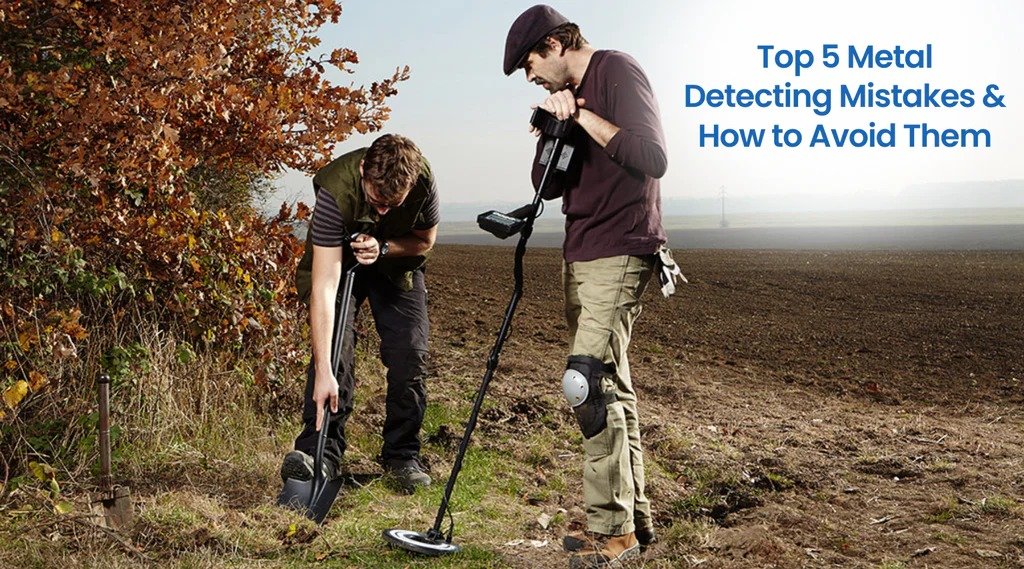
Deep searching with gold and metal detectors can be extremely rewarding—but it also comes with challenges. Many users fail to reach their detector’s true potential, not because of poor equipment, but due to avoidable mistakes in setup, technique, and expectations. Whether you are a beginner or an experienced detectorist, avoiding these common errors can dramatically improve your results.
Mistake 1: Ignoring Proper Ground Balance
One of the most common and costly mistakes is neglecting correct ground balance. Mineralized soil can produce false signals that mask deep targets or cause users to dig unnecessarily.
Why it matters:
Poor ground balance reduces depth, accuracy, and signal clarity—especially in gold-rich or mineral-heavy areas.
How to avoid it:
- Use automatic ground balance when available
- Fine-tune manually in highly mineralized ground
- Rebalance when changing locations or soil types
Mistake 2: Using the Wrong Detector or Coil for Deep Searching
Not all detectors are designed for deep targets. Using a shallow-focused detector or incorrect coil size limits your success.
Common issues:
- Small coils used for deep treasure hunting
- VLF detectors in heavily mineralized soil
- Entry-level machines for professional-level depth
How to avoid it:
- Choose Pulse Induction (PI) or multi-frequency detectors for depth
- Use larger coils when searching for deep, large targets
- Match detector technology to your terrain and target size
Mistake 3: Expecting Unrealistic Depth Performance
Marketing claims often exaggerate detection depth. Believing a detector will find small gold pieces several meters underground leads to frustration and misuse.
Reality check:
- Depth depends on target size, soil, moisture, and mineralization
- Larger objects are detectable deeper than small ones
- Experience improves depth interpretation
How to avoid it:
- Learn your detector’s real-world limits
- Test depth performance with known targets
- Focus on signal quality, not just depth numbers
Mistake 4: Swinging Too Fast or Inconsistently
Deep targets produce weak, subtle signals. Fast or uneven swinging causes these signals to be missed or misinterpreted.
Why it’s a problem:
- Inconsistent coverage creates blind spots
- Weak signals require slow, controlled movement
How to avoid it:
- Maintain a steady, slow swing speed
- Keep the coil close to the ground
- Overlap swings for full coverage
Mistake 5: Misinterpreting Signals and Skipping Training
Many deep signals sound unclear or broken. Inexperienced users often ignore them, assuming they are ground noise.
Common mistakes:
- Ignoring faint or unstable signals
- Over-relying on discrimination at depth
- Skipping user manuals and training modes
How to avoid it:
- Dig questionable deep signals when learning
- Reduce discrimination for deep searches
- Practice with test targets at known depths
Bonus Tip: Failing to Adjust Settings for Deep Search Mode
Some detectors have dedicated deep-search or all-metal modes that users never activate.
What to do:
- Use all-metal mode for maximum depth
- Adjust sensitivity carefully to avoid noise
- Recheck settings regularly during long sessions
Frequently Asked Questions (FAQs)
What is the best detector type for deep searching?
Pulse Induction (PI) and two-box detectors are best for deep targets.
Does increasing sensitivity always improve depth?
No. Excessive sensitivity can create noise and reduce accuracy.
Are deep targets harder to identify accurately?
Yes. Deep signals are weaker and require experience to interpret.
Should beginners focus on deep searching?
It’s better to master shallow detection first before moving deeper.
Conclusion
Deep searching with gold and metal detectors is as much about technique and understanding as it is about technology. By avoiding these five common mistakes—poor ground balance, wrong equipment choice, unrealistic expectations, improper swinging, and signal misinterpretation—you can significantly improve your success rate.
With patience, proper setup, and continuous learning, your detector will reveal what many others miss beneath the surface.